On the Poetry Path
Grieving but Grateful

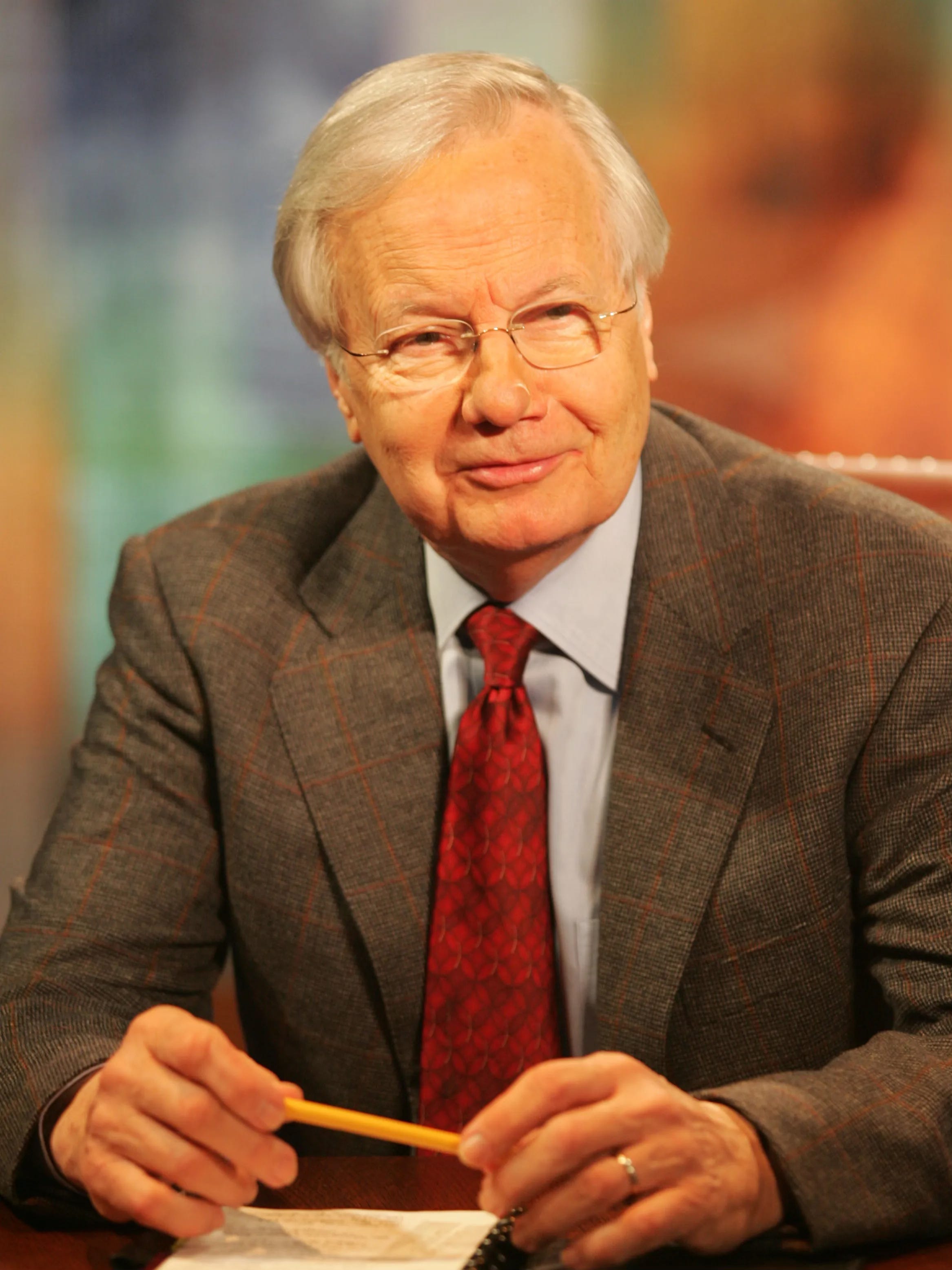
I changed this post. It was supposed to be about my trip to the Arts Education Conference at the Kennedy Center last week, but someone very important to the evolution of my poetry career died, so I wanted to take the time to honor Bill Moyers today.
.
Where I was when I heard the news of his passing was full of significance and meaning. He was the one who ushered me into my professional poetry career with his show on PBS, The Language of Life, where he showcased the Dodge Poetry Festival in the early ’90s.
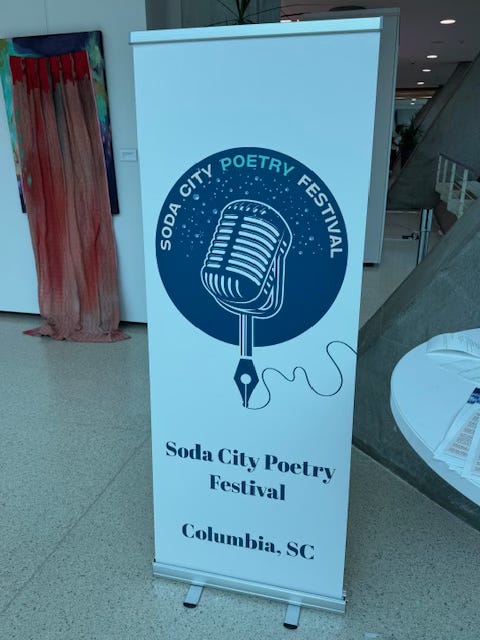
Oddly enough, I was attending and featuring at the Soda City Poetry Festival—on a panel and reading—hosted by Jennifer Bartell Boykin, the Poet Laureate of Columbia. I was in the audience when one of the River Poets panelists mentioned his passing. I audibly gasped. Ed Madden, my poet friend and former Poet Laureate of Columbia, was sitting right behind me and quietly confirmed, “Yes, he died yesterday.” I had to contain myself—I was filled with sorrow and disbelief. I took a deep breath and realized I was exactly where I was meant to be. What better place could I be to learn about his passing than at a poetry festival? He was a true lover of poetry. The timing was synchronistic. The moment was grace-filled. It was mystical.
Thirty years ago, when I was diagnosed with fibromyalgia and floundering—uncertain what to do with my ailing body and my life—Bill Moyers’ show held the answer to my question to the universe. Though I was pain-ridden and aimless, I turned on the television and saw three amazing poets: Lucille Clifton, Coleman Barks, and Jimmy Santiago Baca.
It was Lucille Clifton’s poem, won’t you celebrate with me, that held an invitation that seemed personally crafted for me. That poem was a lightning rod—it struck me directly in the heart. It reminded me that I had written poetry in the eighth grade.
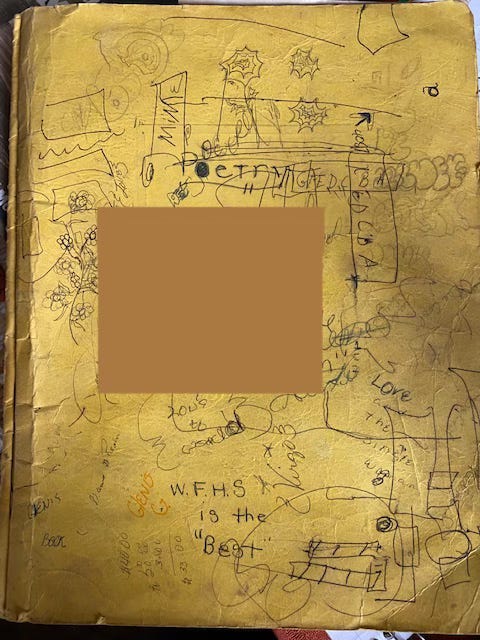
The poem reminded me that I was a poet. Watching and witnessing poets on that show, The Language of Life, gave me both aim and purpose. I decided, after hearing Clifton recite that poem, that poetry was the path I would travel.
Coleman Barks was performing with his band and reciting Rumi. Through Barks, the 13th-century mystic poet seemed to have a message for me too:
“Today, like every other day, we wake up empty and frightened.
Don’t open the door to the study and begin reading.
Take down a musical instrument.
Let the beauty we love be what we do.”
I remember buying the anthology. It was the most expensive book that I bought up to that date, but it was worth it. I read it like the bible.
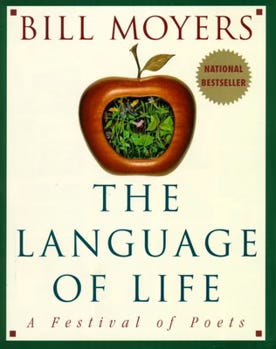
This book and the series helped me to remember what I loved. I loved the arts. I loved writing. I loved poetry.
This moment came exactly when I needed it. Dr. Jeffery Lawson, my rhuemotologist had just diagnosed me with fibromyalgia. He told me, “You will not die from this, but you will sure wish you would have.” It felt like a dire prognosis. But he followed it with an affirmational chaser: “You are a smart woman, and you will figure it out.” I thought to myself that he was right. I am smart. It was the first time anyone had ever said that to me—even though the signs were everywhere. No teacher, professor, or parent had ever said those words. It was a monumental moment.
I did figure it out—with the help of a PBS show and the power of poetry.
Jimmy Santiago Baca was on the show speaking about his time in prison and how poetry helped him survive. He was speaking to my counselor self. I knew I had a passion—and a mandate—to go into marginalized spaces with poetry. And that is what I did. I went to prisons, shelters, and juvenile correctional facilities to perform and teach poetry workshops.
.
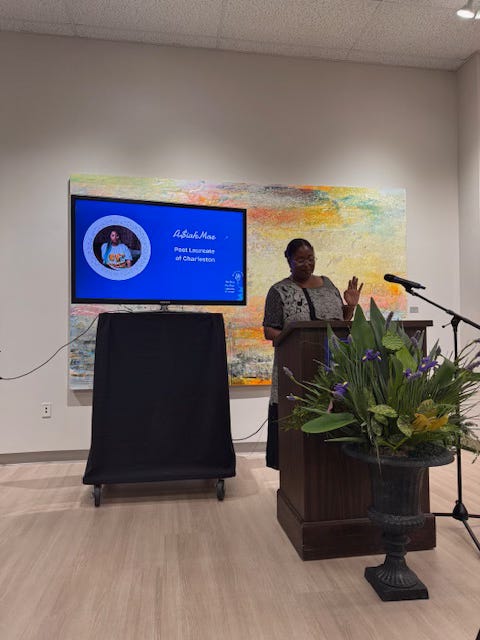
At the South Carolina Poet Laureates’ dinner last night, Aisah Mae shared how Marjory Wentworth had been her professor in college—then how she saw me perform at the Richland Library in Columbia when she was five years old. She remembered my poem “Hats.”She said she pointed at me and told her mama, “That’s what I want to do.” Her mama replied, “That’s what Maya Angelou does.” This weekend has been full of circles completing their turns—as Aisa Mae is now the Poet Laureate of South Carolina.
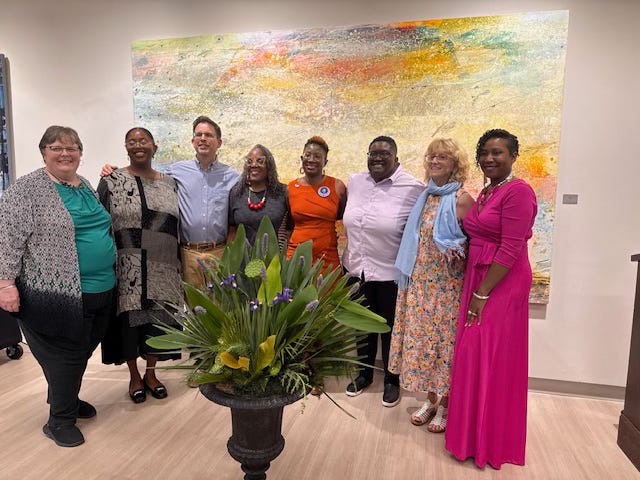
Pictured: Jo Angela Edwins, Poet Laureate of the Pee Dee; Aisah Mae, Poet Laureate of Charleston; Ed Madden, former Poet Laureate of Columbia; Glenis Redmond, Poet Laureate of Greenville; Jennifer Bartell Boykin, Poet Laureate of Columbia; Marlanda Dekine, Poet Laureate of Georgetown County Libraries; Marjory Wentworth, former Poet Laureate of South Carolina; and Carlo Dawson, Poet Laureate of Rock Hill, are all poets who have served or are currently serving their communities with distinction, carrying the mantle of literary leadership across South Carolina.
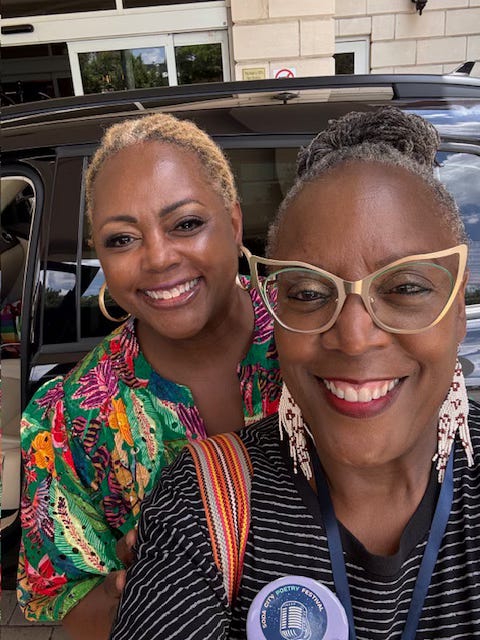
The circles kept circling. At the hotel, I get out of my car, and I hear my name being called. It was Melody Samuel, the mother of Jada Samuel, Miss South Carolina 2023. She reminded me that when I received the Women’s Making History Award about ten years ago, I had shared my philosophy and how it made a profound impact on her daughter. “Don’t strive to be in the limelight, but strive to be the light.” I was pleased those words have stayed with Jada. She is indeed a bright, brilliant and beautiful light.
.
I was happy to be surrounded by friends and the poetry community this weekend. I enjoyed connecting with this Low Country poet, Yvette Murray. She is powerful poet and storyteller. She is making strides and carving her own poetry path.
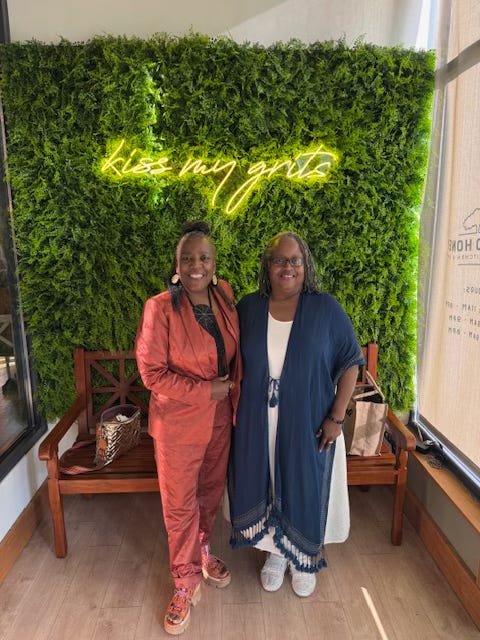
Here I am pictured in my Wildfang burnt orange suit––complete with my orange Sorel platform sandals. I am wearing my new statement piece necklace that I purchased in Missoula, Montana at the Sacred Ally. If you know me, you know that I love fashion. It is one of my greatest loves too. It is part of poetic expression. Someone said to me at the festival said, “You are activating your 2nd chakra, the sacral chakra.” I did not think about that, but it is my favorite color.
I attended the Upstate Poetry Reading. They were phenomenal: Tinasha LaRayé, Richard Taylor and Millie Tullis. They represented the Upstate wonderfully.
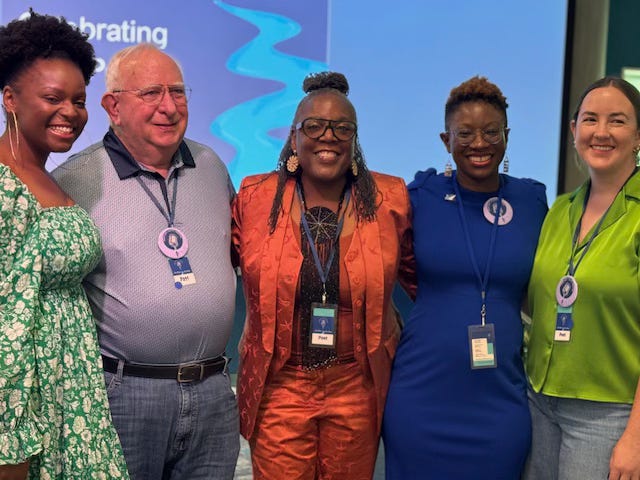
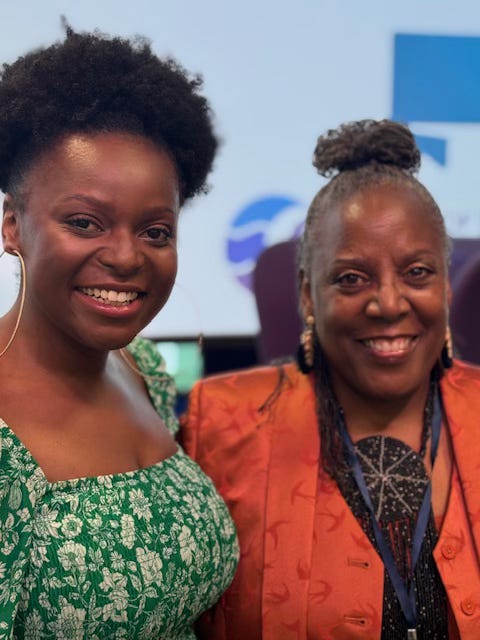
I encouraged Tinasha and Richard to submit to the festival.
Tinasha read and performed magnificently. I was personally glad that she read her Juneteenth poem as I was in Montana during Juneteenth and I did not get to witness it. It was phenomenal. I bought Richard’s amazing book, Letters to Karen Carpenter.
I had a wonderful time at the festival. Eventhough I was both grieving and grateful. Yet, I honoring and reflecting on Bill Moyer’s feels right. It feels timely. He did groundbreaking work as a journalist, but The Language of Life gave me life. It gave me a path. It pointed me toward my livelihood.
This is the thirtieth year of my career as a poet and teaching artist. I will do my best to honor the man upon his leaving this planet. On my way home, I will stop at a state park. I will sit in nature. I will reflect on his meaning in my life. I will breathe. I will write. I will grieve. I will release. I will take note and live.
Thank you, Bill Moyers, for following your heart. Because you did, you expanded mine—and gave me direction.
Oh Glenis, me, too. But when I heard that Bill had passed, I was not near anyone who would understand the deep and personal loss I felt. I should have known you would feel it, too. There have been many decades since I heard and saw and felt your presence in the same room, yet you are back again now! And although I cannot hear your voice I feel your presence in my life and I am so very glad you are in my world. ❤️